← All education

THE NETCARAT EDUCATION SERIES

Four details. One diamond.

Understand cut, color, clarity and carat weight, then consider how they work together in the diamond you choose.

Explore the guide
Four details. One diamond.

THE ESSENTIAL IDEA

Read the grades together. The appearance of the individual diamond matters as much as any single label.

UNDERSTAND THE DETAILS

Cut

Cut considers proportions, facet arrangement and finish. These influence brightness, fire and the pattern of sparkle as the stone moves.

GIA’s standard cut grades apply to eligible round brilliant diamonds. Fancy shapes need an assessment of their appearance, proportions and finish rather than assuming the same cut scale.

Reference scale: Excellent · Very Good · Good · Fair · Poor

Cut is different from shape. Compare the diamond in more than one lighting environment.
Cut

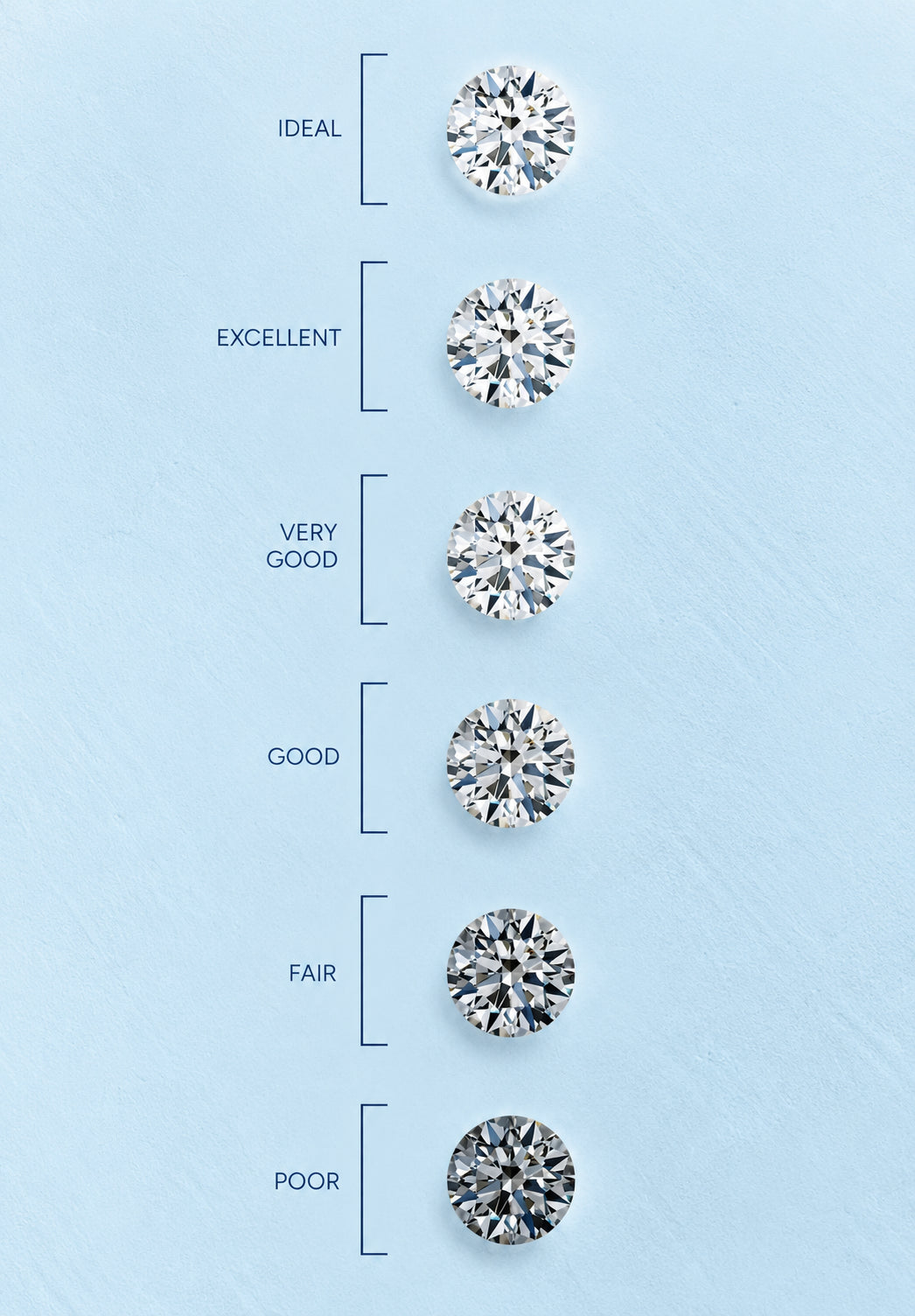
How to read a cut grade.

Brightness, fire and the changing pattern of sparkle are part of a diamond’s visual character. Compare the stone in photographs or moving video and under more than one lighting condition.

The scale below is GIA’s conventional natural round-brilliant cut scale. A seller’s “Ideal” description may refer to a different system. Confirm the laboratory and the report’s actual terminology.

  1. Excellent01
  2. Very Good02
  3. Good03
  4. Fair04
  5. Poor05

A reference to the grade labels, not a simulation of light performance.
UNDERSTAND THE DETAILS

Color

The GIA D-to-Z scale describes increasing yellow or brown body color in the conventional color range. D represents colorless; later letters indicate progressively more visible color.

Fancy-color diamonds are assessed differently. Small grade differences may be difficult to see without controlled comparison.

Reference scale: D–F · G–J · K–M · N–R · S–Z

Consider the appearance of the actual diamond, along with its setting, rather than the letter alone.

Color

Understanding the D-to-Z scale.

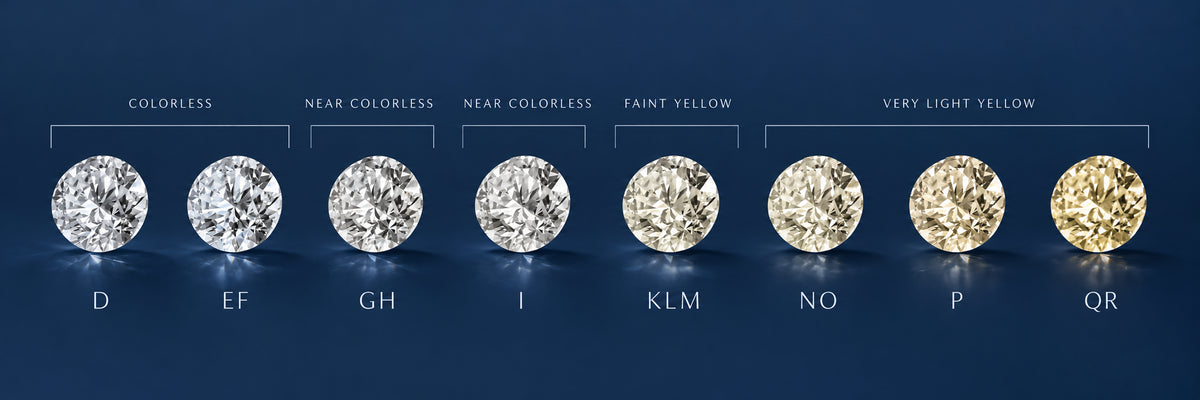
For diamonds in the conventional color range, the D-to-Z scale describes increasing yellow or brown body color. The groups below help organize the grades; they are not a color-calibrated simulation.

Fancy-color diamonds are assessed differently. Evaluate the actual stone alongside the metal color and setting you prefer.

  1. D–FColorless
  2. G–JNear colorless
  3. K–MFaint
  4. N–RVery light
  5. S–ZLight

Illustrative color groups. Screen appearance is not a grading standard.

UNDERSTAND THE DETAILS

Clarity

Clarity describes internal inclusions and external blemishes. Graders consider their size, nature, position, number and visibility under 10× magnification.

The natural-diamond GIA scale spans 11 grades, grouped into Flawless, Internally Flawless, Very Very Slightly Included, Very Slightly Included, Slightly Included and Included.

Reference scale: FL · IF · VVS1–2 · VS1–2 · SI1–2 · I1–3

Ask how the characteristics affect the specific stone’s appearance and durability. A grade alone does not guarantee an eye-clean appearance.

Clarity

A closer look at clarity.

Clarity is assessed under 10× magnification. The position, nature and visibility of a characteristic can matter to the appearance of the individual stone.

The 11 natural-diamond grades are grouped below. A grade alone does not promise an eye-clean appearance or describe every durability consideration.

  1. FLFlawless
  2. IFInternally Flawless
  3. VVS1 · VVS2Very Very Slightly Included
  4. VS1 · VS2Very Slightly Included
  5. SI1 · SI2Slightly Included
  6. I1 · I2 · I3Included

Six categories containing 11 grades. Review the individual stone as well as its grade.

UNDERSTAND THE DETAILS

Carat

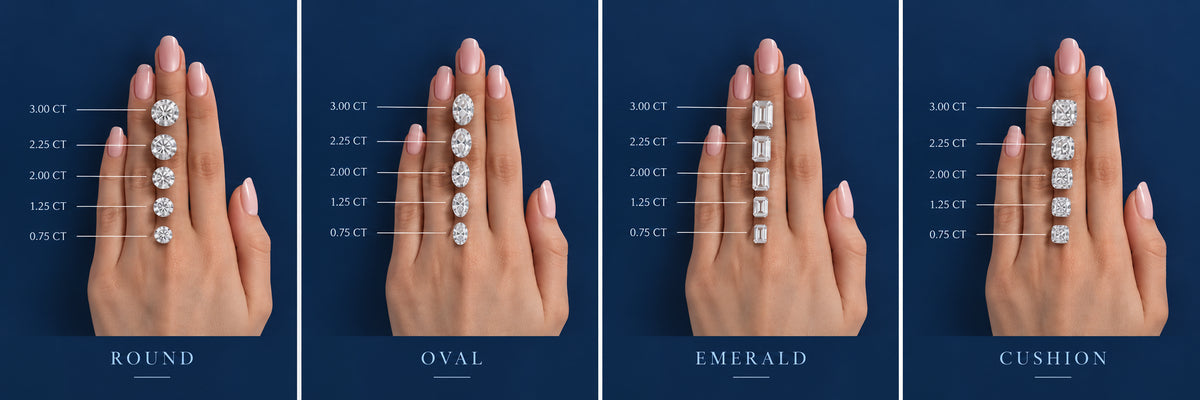
One metric carat equals 0.2 grams. Carat weight is a measure of mass, rather than a direct measurement of the diamond’s width.

Two diamonds of equal weight can differ in visible size because of their shape and proportions. The report’s millimeter measurements help you compare their dimensions.

Reference scale: 0.50 ct · 1.00 ct · 1.50 ct · 2.00 ct

Carat describes a gemstone’s weight; karat describes gold purity. They are different measurements.

Carat

Weight and appearance.

One carat equals 0.2 grams, and one carat is divided into 100 points. Carat describes weight rather than a fixed width or diameter.

Compare the report’s millimeter measurements. A round, oval and emerald-shaped diamond of equal weight can have different face-up dimensions.

0.50 ct0.10 g
1.00 ct0.20 g
1.50 ct0.30 g
2.00 ct0.40 g

Circles are conceptual, not actual-size representations. Compare millimeter measurements for visible size.

UNDERSTAND THE DETAILS

Read the report in context.

The scales in this guide describe conventional natural-diamond grading. Laboratory-grown reports may use different terminology depending on the laboratory, service and report date.

A report describes the stone; it is not a monetary appraisal. Compare photographs, video and millimeter measurements alongside the document.

A LITTLE MORE CLARITY

Questions, answered.

Does a larger carat weight always look bigger?

No. Shape and proportions affect face-up dimensions. Compare measurements rather than weight alone.

YOUR NEXT STEP

A little knowledge.
A confident choice.

Bring your questions to Netcarat. Explore the details that matter to your next piece.